Table of Contents
Ever found yourself jolted awake at 5 AM by a paw to the face and an insistent meow that translates to “Human, my bowl is empty”? Or rushed home during lunch breaks, sacrificing your own meal to ensure your feline overlord doesn’t go hungry? You’re not alone. For cat parents juggling busy schedules, travel, or simply the desire for more sleep, programmable cat feeders have evolved from luxury gadgets to essential household tools.
But here’s the thing: diving into the world of automatic feeding can feel overwhelming when you’re greeted by a dizzying array of options featuring everything from smartphone integration to microchip recognition. This comprehensive guide cuts through the noise, focusing purely on what beginners need to know before investing in their first programmable cat feeder. We’ll explore the mechanics, must-have features, and practical considerations that separate reliable feeding solutions from expensive paperweights—no brand bias, just expert insights to help you make an informed decision.
Top 10 Programmable Cat Feeders For Beginners
Detailed Product Reviews
1. PETULTRA Automatic Cat Feeder: 4L Timed Cats Food Dispenser Programmable 1-6 Meal for Cat and Small Medium Dog- Auto Pet Feeder Easy to Set Up Dual Power Supply with Desiccant Bag| Detachable Washable

Overview: The PETULTRA Automatic Cat Feeder delivers reliable scheduled feeding through a straightforward, non-connected design. This 4-liter dispenser manages up to six daily meals with 20 portions each, accommodating cats and small-to-medium dogs. The system emphasizes mechanical consistency over smart features, making it ideal for owners who prioritize dependable operation without app dependency.
What Makes It Stand Out: Its anti-clogging double rotor design and 40-degree sloped passage ensure consistent food flow, even with irregular kibble shapes—a common failure point in budget dispensers. The dual power system (adapter plus three D-size batteries) provides genuine outage protection. The secure lock lid and integrated desiccant bag effectively prevent food spoilage and clever pet break-ins, addressing two major owner concerns.
Value for Money: Positioned in the mid-range, this feeder justifies its cost through robust engineering rather than connectivity. It outperforms entry-level models with superior jam prevention and power backup while avoiding WiFi premiums. For owners who don’t need remote access, the investment delivers measurable benefits in meal reliability and food preservation.
Strengths and Weaknesses: Strengths include the exceptional anti-clogging mechanism, effective dual power backup, fully detachable cleaning design, and secure lid. Weaknesses are limited six-meal scheduling (competitors offer ten), no app connectivity, and D-size batteries not included. The 4L capacity may require frequent refills for larger pets.
Bottom Line: The PETULTRA excels for owners seeking dependability without complexity. If smartphone control isn’t essential and you value mechanical reliability, this feeder offers excellent performance for its price point.
2. IMIPAW Automatic Cat Feeder, 3L Timed Dry Food Dispenser with Desiccant, Programmable Portion Control, Dual Power Backup, 10 Meals Daily, 15 Portions Per Meal, Suitable for Small Pets, Easy Setup

Overview: The IMIPAW Automatic Cat Feeder bridges basic programmable models and premium smart feeders. With a 3-liter capacity and proximity-based app control, it offers ten-meal daily scheduling while maintaining straightforward operation for small pets. The system balances convenience with simplicity, targeting owners wanting easier programming without full remote access.
What Makes It Stand Out: The “PetNetizen” app eliminates tedious button sequences for setup and monitoring. Its six-compartment rotor ensures remarkably consistent portions—critical for weight management. The dual rotor structure prevents jamming, while the internal tilt angle creates smooth delivery. Proximity control via Bluetooth provides convenience without subscription fees, working within range for daily adjustments.
Value for Money: This feeder occupies a sweet spot between dumb dispensers and WiFi models. You get app convenience for initial programming and logging without paying for true remote access you may rarely need. The 3L capacity suits single-pet households, preventing food staleness issues common with oversized hoppers.
Strengths and Weaknesses: Strengths include intuitive app interface, ten-meal scheduling, reliable portion control, dual power backup, and secure locking lid. The desiccant maintains freshness. Weaknesses: app only works nearby (not true remote), 3L capacity limits multi-pet use, and D batteries aren’t included. Some users report occasional Bluetooth connectivity hiccups.
Bottom Line: Ideal for tech-curious owners wanting easier programming without vacation-feeding needs. The IMIPAW offers genuine convenience upgrades over basic models without the premium price of full smart feeders, making it perfect for daily home use.
3. oneisall Automatic Cat Feeder with 5G WiFi, Automatic Cat Food Dispenser for 2 Cats Small Pets, 20 Cups/5L Timed Dry Food Dispenser with APP Control

Overview: The oneisall Automatic Cat Feeder represents the premium tier with 5G WiFi connectivity enabling true remote management for multi-pet households. Its generous 5-liter capacity serves two cats for up to ten days, while the app supports scheduled and manual feeding from anywhere with internet access. This is a fully connected solution for serious pet owners.
What Makes It Stand Out: Dual-band WiFi (5G/2.4G) provides exceptional connection stability, reducing frustrating offline periods common with 2.4G-only models. App sharing with family members ensures feeding continuity during travel. The 10-second voice recorder adds a personal touch, playing your call before meals to comfort pets. The massive 20-cup capacity minimizes refill frequency significantly.
Value for Money: While priced higher than non-WiFi models, the premium is justified for frequent travelers or multi-pet homes. Robust app functionality, superior connectivity, and capacity combine to deliver value that basic timers cannot match. Consider it insurance against missed meals and pet anxiety when you’re away.
Strengths and Weaknesses: Strengths include genuine remote access, stable 5G/2.4G connectivity, family app sharing, large capacity, voice messaging, and feeding logs. Weaknesses: higher price point, potential overkill for single pets, requires stable home internet, and setup may challenge less tech-savvy users. No battery backup mentioned, creating vulnerability during outages.
Bottom Line: For owners needing reliable remote feeding control, the oneisall is unmatched. The 5G connectivity and app sharing make it perfect for multi-pet families or frequent travelers who demand consistent, monitorable feeding from anywhere.
4. Miaosical Automatic Cat Feeder,2.4G WiFi Timed Auto Cat Food Dispenser with 10s Voice Recorder,Dual Power Supply,4.2L Auto Cats Feeder(Black, 4.2L WiFi Single Bowl)

Overview: The Miaosical Automatic Cat Feeder delivers WiFi-enabled convenience in a practical 4.2-liter package. Connecting via 2.4GHz networks, it allows remote schedule management through the Smart Life app while supporting up to ten daily meals with precise portion control for kibble 2-15mm in size. This is a balanced smart feeder for everyday use.
What Makes It Stand Out: Integration with the widely-used Smart Life app ecosystem ensures compatibility with other smart home devices and a polished interface. The personalized 10-second voice reminder helps pets associate the feeder with your presence, reducing mealtime anxiety. The tool-free removable design simplifies cleaning—a common pain point with automatic feeders that often require disassembly tools.
Value for Money: This feeder hits the value bullseye for owners wanting legitimate remote access without flagship pricing. It offers core smart features—app control, voice messaging, dual power—at a mid-range price. The 4.2L capacity suits most cats and small dogs perfectly, avoiding waste while reducing refill frequency.
Strengths and Weaknesses: Strengths include true WiFi remote access, voice recording, dual power reliability, tool-free cleaning, and secure locking lid. The 2.4G limitation may cause connectivity issues in congested WiFi environments. D batteries aren’t included. The moderate capacity might require frequent refills for larger pets or multi-pet homes.
Bottom Line: A well-balanced choice for owners seeking genuine smart functionality on a budget. The Miaosical offers reliable remote feeding and helpful features without unnecessary complexity, making it ideal for first-time smart feeder buyers wanting proven convenience.
5. 5L/21 Cups Automatic Cat Feeder, Timed Automatic Pet Feeders, Cat Dry Food Dispenser Dual Power, 10 Meals Programmable 1-15 Portion Control Cats Feeder, Pet Food Dispenser for Cats & Puppy(Not WiFi)

Overview: The DUDUPET Automatic Cat Feeder emphasizes capacity and local smart control through Bluetooth connectivity. Its substantial 5L hopper holds 21 cups of dry food, while the “PetNetizen” app allows programming within a 10-meter range. The system supports ten daily meals with 1-15 portion control per feeding, targeting large households.
What Makes It Stand Out: The four-layer freshness preservation system with desiccant and enhanced lid sealing maintains food quality exceptionally well. Bluetooth enables 180+ days of battery life using AA cells—far longer than WiFi models. The massive capacity serves multiple pets or supports extended travel. The dual power system uses standard AA batteries, making replacement convenient and affordable compared to D-cells.
Value for Money: This feeder offers maximum capacity at a competitive price point. The Bluetooth limitation reduces cost while preserving app convenience for setup and monitoring. For owners who don’t need remote vacation feeding, it delivers smart features where they matter most—initial programming and tracking—while avoiding premium WiFi pricing.
Strengths and Weaknesses: Strengths: huge 5L capacity, exceptional battery life, four-layer freshness system, AA battery compatibility, and affordable pricing. Weaknesses: Bluetooth range limits true remote access, requires Android GPS for pairing, no WiFi means no vacation feeding control, and batteries aren’t included. The 10-meter range may not cover entire homes.
Bottom Line: Perfect for large households or multi-pet families prioritizing capacity and food freshness over remote access. The DUDUPET excels when you’re home but busy, though frequent travelers should consider WiFi alternatives for true remote management.
6. PETLIBRO Automatic Cat Feeder – 3L Programmable Pet Food Dispenser with Airtight Storage, Timed Portion Control, Voice Meal Call & Dual Power Supply, Clog-Free Healthy Feeding for Cats & Small Dogs

Overview: The PETLIBRO 3L Automatic Cat Feeder delivers reliable portion-controlled feeding for cats and small dogs. Programmable for up to six daily meals with 1-50 portion flexibility, it supports healthy weight management. The unit emphasizes food preservation through a patented rotor system, twist-lock lid, sealing strip, and included desiccant bag, keeping kibble fresh and flavorful for extended periods.
What Makes It Stand Out: This feeder excels in freshness preservation and power reliability. The patented rotor mechanism prevents clogging while maintaining precise portions. Its dual power system—USB-C plus 3 D-cell batteries—provides 30-50 days of backup during outages, surpassing many competitors. The 10-second voice recording feature adds personal comfort, calling pets by your voice during mealtime, reducing separation anxiety.
Value for Money: Positioned in the mid-range segment, this feeder offers premium features without premium pricing. The airtight storage system significantly reduces food waste from stale kibble. Compared to basic models lacking battery backup or proper sealing, the PETLIBRO justifies its cost through durability and versatility. The USB-C power option also reduces long-term battery expenses, enhancing overall value.
Strengths and Weaknesses: Strengths include superior food preservation, reliable dual power, flexible scheduling, anti-clog design, and comforting voice feature. The 3L capacity suits cats and small dogs perfectly. Weaknesses include limited capacity for larger dogs or extended travel, lack of WiFi connectivity for remote monitoring, and initial portion calibration that may require fine-tuning. The interface, while functional, feels slightly dated.
Bottom Line: The PETLIBRO 3L feeder is ideal for owners prioritizing food freshness and mechanical reliability over smart features. Its robust construction and thoughtful engineering provide peace of mind for daily use and short absences. While not the most technologically advanced, its dependable performance and superior sealing make it a top choice for health-conscious pet parents.
7. VOLUAS Automatic Cat Feeders - Pet Dry Food Dispenser with Timer, Automatic Cat Feeders with Desiccant Bag, Programmable Portion Size Control 4 Meals Per Day, 10s Voice Recorder

Overview: The VOLUAS Automatic Cat Feeder provides straightforward, dependable feeding automation for busy households. With a generous 4L capacity, it accommodates dry kibble up to 15mm diameter for both cats and small-to-medium dogs. The system programs 1-4 meals daily with precise timing and portion control, maintaining consistent routines when owners are away for work or short trips.
What Makes It Stand Out: The VOLUAS distinguishes itself through generous capacity and user-friendly simplicity. Its 4L hopper stores several days’ worth of food, reducing refill frequency. The dual power system—wall adapter plus 4 D-cell batteries—ensures uninterrupted operation during outages. The 10-second voice recorder helps pets feel connected to owners, effectively reducing mealtime anxiety without complex technology.
Value for Money: This feeder offers excellent value in the budget-to-mid-range category. The 4L capacity exceeds many competitors at similar price points. While lacking WiFi, it provides reliable core automation. The inclusion of a desiccant bag and dual power supply at this price represents strong value compared to basic single-power models. It’s an economical choice for reliable performance.
Strengths and Weaknesses: Strengths include large capacity, reliable dual power, easy cleaning with removable tray, and clog-resistant design for kibble up to 15mm. Simple button programming requires no smartphone. Weaknesses include limited meal scheduling (max 4 meals versus 6-10 in competitors), no remote monitoring capabilities, basic plastic construction, and less granular portion control. The voice playback quality is adequate but not exceptional.
Bottom Line: The VOLUAS feeder is perfect for owners wanting reliable, no-fuss automation without premium costs. Its large capacity and dual power make it ideal for weekend trips and daily use. While it won’t impress tech enthusiasts, its straightforward operation and dependable performance serve most households excellently. Best value for those prioritizing capacity and simplicity over connectivity.
8. IMIPAW Automatic Cat Feeder, 5G WiFi Cat Food Dispenser with APP Remote Control, Pet Dry Food Smart Feeder, Programmable Timed Feeding, Dual Power Supply, 1-10 Meals Per Day, Desiccant Bag, Small pets

Overview: The IMIPAW WiFi-enabled feeder brings smart home convenience to pet care with 5G connectivity. Through the “PetTech” app, owners can schedule up to 10 meals daily with 1-20 servings per meal, view feeding history, and allow multiple family members to control the device. Designed for small pets, it features a dual rotor structure that prevents jams and ensures consistent portions.
What Makes It Stand Out: The 5G WiFi compatibility is a significant advantage, providing faster, more stable connections than 2.4GHz-only models. The dual rotor design offers exceptional reliability in portion control and jam prevention. A safety-locking lid prevents clever pets from accessing stored food. The app enables immediate feeding without disrupting schedules and supports multiple users, enhancing household coordination.
Value for Money: Positioned in the mid-to-premium range, the IMIPAW justifies its price through advanced connectivity and robust engineering. The 5G support future-proofs the investment, while the dual rotor system reduces maintenance issues. Compared to non-WiFi models, the premium is reasonable for remote monitoring. However, batteries are not included for backup power, slightly diminishing overall value.
Strengths and Weaknesses: Strengths include dual-band WiFi (5G/2.4G), excellent jam prevention, secure locking lid, flexible scheduling (10 meals), and multi-user app access. The internal tilt-angle design ensures smooth dispensing. Weaknesses include unspecified capacity that appears smaller than competitors, lack of included batteries, and reliance on app connectivity for initial setup. The app interface may feel less polished than major brand alternatives.
Bottom Line: The IMIPAW excels for tech-savvy owners wanting advanced control and monitoring. Its 5G connectivity and anti-theft lid make it ideal for households with clever, food-motivated pets. While capacity may be modest, the reliability and smart features provide excellent peace of mind. Recommended for those prioritizing connectivity and security over maximum food storage volume.
9. PETLIBRO Automatic Cat Feeder for 2 Cats, 5G&2.4G WiFi Pet Feeders, 5L Programmable Cat Food Dispenser with Airtight Lock-Fresh Technology, Dual Stainless Steel Bowls, Low Food Sensor

Overview: The PETLIBRO Dual-Cat WiFi feeder specifically addresses multi-pet households with intelligent engineering. This 5L automatic dispenser features dual stainless steel bowls that evenly distribute food to prevent competition and food guarding. Compatible with both 5GHz and 2.4GHz WiFi, it offers app-based control for up to 10 daily meals, real-time monitoring, and comprehensive smart alerts for food shortage, clogs, and low battery.
What Makes It Stand Out: The dual-bowl configuration is uniquely tailored for two-cat families, ensuring equal portions and eliminating mealtime conflicts. The low food sensor with instant smartphone notifications prevents unexpected empty bowls. Infrared anti-clogging technology stops operation if blockages occur, enhancing safety. Airtight Lock-Fresh technology with desiccant and sealing strip maintains optimal food quality.
Value for Money: This premium-priced feeder justifies its cost through specialized multi-pet design and advanced sensors. The dual stainless steel bowls offer superior hygiene and durability compared to plastic alternatives. Smart alerts provide exceptional peace of mind. For two-cat households, the value exceeds purchasing two separate feeders, making it a cost-effective solution despite the higher initial investment.
Strengths and Weaknesses: Strengths include innovative dual-bowl design, dual-band WiFi, smart alerts, stainless steel bowls, large 5L capacity, and comprehensive safety features. Voice recordings automatically delete old messages. Weaknesses include higher price point, larger footprint requiring more space, and potential complexity overwhelming less tech-savvy users. Some owners report occasional app connectivity hiccups requiring router adjustments.
Bottom Line: This PETLIBRO model is the premier choice for two-cat households seeking smart automation. Its specialized design eliminates mealtime conflicts while providing comprehensive monitoring. The robust feature set and quality materials justify the investment. Ideal for owners wanting maximum control, hygiene, and peace of mind for multiple pets. Highly recommended for tech-friendly multi-pet families prioritizing harmony and health.
10. Automated Cat Feeder,Clear 4.2L Dry Food Dispenser with Single Bowl,Programmable Timed Pet Feeder for Up to 6 Daily Meals,10-Second Voice Message & Dual Power Backup (Black, 4.2L Press Version)
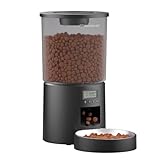
Overview: This no-frills automated feeder prioritizes simplicity and visibility for straightforward pet care. The clear 4.2L hopper allows instant food level checks without opening the unit, preventing unexpected shortages. Programmable for up to six daily meals with 1-12 portions each, it serves cats and small dogs reliably. The button-controlled interface eliminates WiFi dependency, making setup accessible for all users.
What Makes It Stand Out: The transparent design is genuinely practical, solving a common pain point of hidden food levels. The reverse rotation anti-clog mechanism actively prevents jams—a feature uncommon in budget models. Its dual power system (AC adapter plus 3 D-cell backup) ensures continuous operation. The absence of app connectivity becomes a strength for those wanting reliable, simple operation without smartphone dependence or privacy concerns.
Value for Money: This feeder offers exceptional value in the budget category. The clear hopper and anti-clog system deliver premium utility at an entry-level price. While lacking WiFi, it provides core automation features reliably. The 4.2L capacity competes with higher-priced models. For cost-conscious buyers wanting dependable performance without smart features, it’s nearly unbeatable in price-to-function ratio.
Strengths and Weaknesses: Strengths include transparent hopper, simple button controls, reliable dual power, effective anti-clog mechanism, and easy-to-clean removable parts. No WiFi means no connectivity issues, complex setup, or security vulnerabilities. Weaknesses include limited portion granularity (max 12 portions vs. 50 in premium models), no remote monitoring, basic plastic construction, and manual programming only. Voice message quality is functional but not exceptional.
Bottom Line: Perfect for owners seeking straightforward, reliable feeding automation without technological complexity. The clear hopper and jam-prevention system solve real problems at an attractive price. While it won’t impress tech enthusiasts, its dependable performance and simplicity make it ideal for seniors, gifts, or anyone wanting set-it-and-forget-it convenience. Excellent entry-level choice that focuses on core functionality and reliability.
What Is a Programmable Cat Feeder and Why Do You Need One?
A programmable cat feeder is an automated device that dispenses predetermined portions of food at scheduled intervals, essentially acting as your reliable feeding assistant. Unlike gravity-fed bowls that continuously refill, these smart devices give you precise control over when and how much your cat eats. For beginners, the primary appeal lies in establishing consistent feeding routines that align with your cat’s natural grazing instincts while preventing the obesity that free-feeding often causes.
The real value extends beyond convenience. These devices help manage multi-cat households where one cat steals another’s food, support cats with medical conditions requiring strict feeding schedules, and reduce anxiety for pets who associate their human’s absence with hunger. Think of it as creating predictability in your cat’s world—something felines crave more than anything.
Key Benefits of Automated Feeding for Your Cat’s Health
Consistency is the cornerstone of feline health. Cats thrive on routine, and irregular feeding schedules can trigger stress, digestive issues, and behavioral problems. A programmable feeder delivers meals at the exact same times daily, regulating your cat’s metabolism and preventing the binge-and-fast cycle that many manual feeders inadvertently create.
Weight management becomes significantly easier when you eliminate the guesswork. Overweight cats face serious health risks including diabetes, arthritis, and reduced lifespan. By measuring portions to the gram, automatic feeders prevent well-meaning family members from overfeeding and stop your persuasive cat from convincing multiple household members they’ve “never been fed.” For cats with conditions like hyperthyroidism or diabetes, timed feeding can synchronize with medication schedules, creating a management system that supports treatment protocols.
Essential Features to Look for in Your First Programmable Feeder
Portion Control Precision
The difference between a basic feeder and a truly effective one often comes down to portion accuracy. Look for devices that allow adjustments in small increments—ideally 5-10 gram steps—rather than vague “small, medium, large” settings. This granularity matters because a few extra grams per meal can add up to significant weight gain over months. The mechanism should consistently deliver the same amount, not approximate it. Check whether the feeder uses an auger system, rotating compartments, or a drop-down chute, as each affects precision differently depending on kibble size.
Meal Scheduling Flexibility
Your ideal feeder should accommodate at least 4-6 daily meals, even if you only plan to use 2-3 initially. This flexibility becomes crucial if your vet recommends smaller, more frequent meals or if you need to dispense treats throughout the day. Avoid units with rigid 24-hour cycles that lack customization. The best beginner-friendly models offer intuitive programming that doesn’t require an engineering degree—think digital displays with clear prompts rather than cryptic button combinations that have you reaching for the manual every time.
Food Type Compatibility
Not all feeders handle every food type equally well. Dry kibble feeders dominate the market, but if your cat eats wet food, you’ll need a model with ice packs or cooling features to maintain freshness. Mixed-diet households should consider dual-compartment systems or separate units. Pay attention to kibble size compatibility too—large, irregular-shaped kibble can jam mechanisms designed for small, uniform pieces. Always measure your cat’s typical kibble dimensions and cross-reference with feeder specifications.
Power Source Reliability
Nothing defeats the purpose of an automatic feeder like it failing during a power outage. Dual-power systems that combine AC adapters with battery backup provide essential redundancy. For battery-only models, investigate battery life realistically—manufacturer claims often assume optimal conditions. Lithium batteries typically outperform alkaline in these devices, maintaining consistent power output that prevents timing drift. Consider the cost and environmental impact of battery replacement when calculating long-term value.
Understanding Different Feeder Mechanisms
Rotating Bowl Systems
These feature a circular tray with multiple compartments that rotate to reveal pre-portioned meals. They’re excellent for wet food since each section seals individually, and they’re virtually jam-proof with dry kibble. The trade-off? Limited capacity—typically 5-6 meals maximum—and less flexibility for on-the-fly schedule changes. They excel for short trips or precise medication-meal timing but may not suit cats needing many small daily portions.
Conveyor Belt Dispensers
Using a belt-and-auger system, these feeders push food from a hopper into a bowl. They’re highly accurate with dry kibble and offer large capacities, often holding several pounds of food. The mechanism allows for many small portions throughout the day. However, they can struggle with irregular kibble shapes and may require more frequent cleaning to prevent oil buildup from food. For beginners with single-cat households using standard kibble, this represents a solid middle-ground option.
Drop-Down Hopper Designs
The simplest mechanism involves food falling through an opening when a door slides or rotates open. While cost-effective and reliable, they offer the least portion control precision—food flows until the opening closes. They’re best for cats who self-regulate eating or for supplementing manual feedings rather than being the primary food source. Gravity-fed variants should be avoided entirely for weight management purposes.
Capacity Considerations: Matching Feeder Size to Your Cat’s Needs
Bigger isn’t always better. A massive hopper might seem convenient, but food loses nutritional value and palatability when exposed to air and light over weeks. For most cats, a 4-7 day capacity strikes the right balance—enough for a long weekend away but not so much that food sits stale. Multi-cat households need larger capacities but should consider separate feeders to monitor individual intake.
Calculate your cat’s weekly consumption: an average 10-pound cat eating 200 calories daily consumes roughly 1.5-2 cups of dry food per day, depending on caloric density. Multiply by the number of days you want coverage, then add 20% buffer. Remember that feeders should be emptied and cleaned regularly, so don’t prioritize capacity over maintenance ease.
Power Options: Battery vs. Plug-in vs. Dual Power
Battery-powered feeders offer placement flexibility—no need to position near outlets—but introduce the risk of power depletion. Most use D-cell or proprietary lithium packs. Plug-in models provide consistent operation but become useless during outages unless they have battery backup. Dual-power systems automatically switch to battery when AC power fails, then revert when restored.
For beginners, dual power eliminates anxiety. If choosing battery-only, select models with low-battery indicators and test battery life under real conditions before relying on it for travel. Some advanced units send smartphone alerts when batteries run low, adding another layer of security. Consider your home’s power reliability and your travel frequency when deciding.
Smart Features: Wi-Fi, Apps, and Voice Control Explained
Connectivity features divide into two categories: convenience and necessity. Wi-Fi-enabled feeders with companion apps allow remote schedule adjustments, feeding confirmations, and consumption tracking—valuable for anxious pet parents. However, they introduce potential failure points: router issues, app bugs, or server outages can disrupt feeding.
Voice control through Alexa or Google Home offers novelty but rarely provides functional value beyond manual feeding on demand. For beginners, focus on core reliability first. Smart features should enhance, not replace, robust basic programming. If you travel frequently or have a cat with health issues requiring monitoring, remote access becomes more valuable. Otherwise, a well-designed non-smart feeder often proves more dependable.
Build Quality and Durability: What Beginners Should Know
Your cat will interact with this device daily, and some will try to break into it. Look for BPA-free plastics or stainless steel bowls—the latter being more hygienic and resistant to bacteria. The unit should feel substantial, not flimsy. Check lid security: does it latch firmly enough to withstand a determined cat? Are there gaps where paws can reach internal mechanisms?
Warranty periods reveal manufacturer confidence. One-year warranties are standard; two years suggests better build quality. Read user reviews focusing on longevity—feeders that fail after three months often have design flaws. The motor should operate quietly; loud dispensing can startle cats and create negative associations. Test noise levels if possible, or watch video reviews with sound.
Ease of Cleaning and Maintenance
A feeder that takes 30 minutes to disassemble and clean won’t get cleaned regularly, compromising your cat’s health. Look for dishwasher-safe bowls and hoppers with smooth, accessible surfaces. Avoid complex assemblies with numerous small parts that can trap food debris and bacteria.
The food chute should be wide enough to hand-clean easily. Some models feature removable, washable augers—a significant advantage. Plan on cleaning weekly at minimum, so consider whether the process requires tools or simply lifts apart. Hard water areas should check if components develop mineral buildup easily. Maintenance extends beyond cleaning: some feeders need periodic lubrication of moving parts, while others are maintenance-free.
Safety Features That Protect Your Cat
The best feeders include anti-jam mechanisms that reverse the motor if food gets stuck, preventing motor burnout and ensuring meals still dispense. Look for sensors that detect whether the bowl is full before dispensing—preventing overflow if your cat hasn’t eaten the previous meal.
For multi-pet homes, microchip-enabled feeders open only for the registered cat, preventing food stealing and enabling prescription diet management. This technology uses your cat’s existing microchip or a collar tag, making it invaluable for households with cats on different diets. Even without microchip tech, separate feeding zones with barriers can help.
Installation and Setup: What to Expect
Most feeders require minimal assembly—typically attaching the bowl and setting the clock. Programming complexity varies dramatically. Beginner-friendly models guide you through setup with LCD prompts, while others require referencing diagrams to understand button functions. Before purchasing, watch setup videos to gauge the learning curve.
Placement matters: position the feeder away from litter boxes and water bowls (cats prefer separation), in a low-traffic area where they feel secure. For the first week, place it near their regular feeding spot to ease transition. Test the feeder for several days while you’re home to observe portion accuracy and your cat’s reaction before relying on it for travel.
Troubleshooting Common Issues for First-Time Users
Food jams top the complaint list. This usually stems from using incompatible kibble size or oily food coating internal mechanisms. If jams occur, try switching to a lower-fat kibble or cleaning the dispenser more frequently. Some users find that mixing a small amount of rice with kibble absorbs excess oil and reduces sticking.
Cats refusing to eat from the feeder often stems from noise anxiety or bowl depth. Try operating it manually while present to create positive associations with treats. Shallow, wide bowls prevent whisker fatigue—a real condition where deep bowls stress sensitive whiskers. If your cat is a “pawer,” look for units with protective barriers that prevent them from reaching up the chute.
Transitioning Your Cat to an Automatic Feeder
Never switch cold turkey. Start by placing the feeder next to their regular bowl, unplugged, for several days so they investigate it as neutral furniture. Next, feed their favorite treats from the feeder’s bowl manually. Then, program one small meal daily while continuing regular feedings elsewhere, gradually increasing automatic meals over 1-2 weeks.
Observe your cat’s stress signals: hiding, aggression, or elimination outside the litter box may indicate the transition is too fast. Some cats adapt in days; others need a month. Place a familiar-scented item near the feeder during transition. For particularly anxious cats, consider pheromone diffusers in the feeding area. The goal is making the feeder represent reliability and food security, not stress.
Cost vs. Value: Budgeting for Your First Programmable Feeder
Entry-level feeders start around $30, but these often lack portion precision and durability. Mid-range options ($60-$120) typically offer the best value for beginners—reliable mechanisms, decent capacity, and essential features without overwhelming complexity. Premium smart feeders ($150+) justify their cost through remote monitoring and microchip access, valuable for specific situations but unnecessary for most first-time users.
Factor in long-term costs: battery replacements, potential AC adapters sold separately, and replacement parts like bowls or conveyor belts. A $50 feeder that fails in six months costs more than a $100 feeder lasting five years. Consider it an investment in your cat’s health—preventing obesity-related vet bills often repays the initial cost many times over.
Frequently Asked Questions
Will my cat figure out how to break into the feeder?
Most cats will investigate, but well-designed feeders include secure latches and weighted bases that deter all but the most determined felines. Place the feeder in a corner to limit access angles, and consider models with “cat-proof” locking mechanisms if you have a particularly clever or food-motivated cat. Some owners add aftermarket straps for extra security.
Can I use a programmable feeder for wet food?
Yes, but only feeders specifically designed for wet food with refrigeration or ice pack compartments. Standard dry-food dispensers will spoil wet food within hours. Wet-food feeders typically hold 2-5 portions and keep food fresh for 24-48 hours. For longer periods, consider freeze-dried raw food that rehydrates at dispensing.
How accurate are portion sizes really?
Accuracy varies by mechanism and kibble type. High-quality auger systems typically achieve 95-98% accuracy with uniform kibble. Test your feeder by measuring five consecutive portions on a kitchen scale; variance should be under 10%. Inconsistent portions often indicate jamming, low batteries, or using kibble that’s too large for the mechanism.
What if there’s a power outage while I’m away?
Dual-power feeders automatically switch to battery backup, continuing the programmed schedule seamlessly. Battery-only models obviously continue operating. If you have a plug-in-only feeder, consider an uninterruptible power supply (UPS) like those used for computers—these can power a feeder for days during outages.
Will the feeder work with my cat’s prescription diet?
Absolutely, and this is where feeders shine. Portion control ensures exact dietary compliance, and microchip-enabled models prevent other pets from accessing prescription food. Some vets specifically recommend automatic feeders for diabetic cats or those on weight-management programs. Always verify the kibble size works with your chosen feeder.
How loud are these devices? Will they scare my cat?
Noise levels range from whisper-quiet (under 30 decibels) to noticeably mechanical (50+ decibels). Most cats adapt to moderate noise, especially if you introduce the feeder gradually. Look for models with “quiet operation” in reviews. The first few dispensing cycles may startle them, but food motivation usually overcomes noise aversion quickly.
Can multiple cats share one feeder?
It’s not recommended. You can’t monitor individual intake, and dominant cats may block access. Better solutions include separate feeders for each cat or microchip-enabled units that control access. If you must share, choose a wide bowl and program smaller, more frequent meals to reduce competition.
How often should I clean the feeder?
Wash the bowl daily like any food dish. Deep clean the hopper and mechanism weekly, or every two weeks if using dry food only. Wet food feeders need cleaning after each use. Regular cleaning prevents bacterial growth, oil buildup, and mechanical jams. Build this into your routine immediately—neglected feeders become health hazards.
What happens if the food gets stuck?
Quality feeders include anti-jam features that reverse the motor or alert you. If jamming occurs regularly, switch to a different kibble shape or size, reduce portion sizes per cycle, or increase cleaning frequency. Never force the mechanism manually—this can strip gears. Instead, empty the hopper and run a cleaning cycle.
Are smart feeders worth the extra cost for beginners?
For most first-time buyers, focus on core reliability over connectivity. Smart features add convenience but also complexity and potential failure points. Invest in smart technology only if you travel frequently, have a cat with health issues requiring monitoring, or genuinely want remote control. A dependable non-smart feeder beats a glitchy smart one every time.
See Also
- The 10 Ultimate Best Programmable Cat Feeders for Weight Management in 2026
- The 10 Best Programmable Cat Feeders for Busy Owners in 2026
- The Complete Guide to the 10 Best Travel Cat Feeders for Pet Owners
- The Complete Guide to the 10 Best Automatic Cat Feeders for Indoor Pets
- 10 Affordable Programmable Cat Feeders That Don’t Sacrifice Quality in 2026